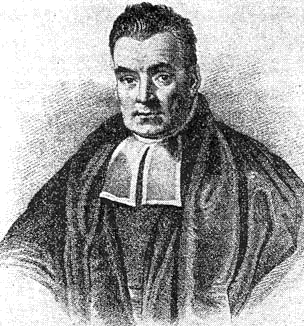
 photo from Wikipedia
This is possibly a portrait of Thomas Bayes, the creator of Bayes' Theorem. He was an English non-conformist Presbyterian minister and statistician. But you don't need me to regurgitate his Wikipedia entry. He never actually published the equation for which he is now the man of the moment-- it was published after his death.
He was elected a Fellow of the Royal Society in 1742, some think because of his 1736 work (published anonymously) "An Introduction to the Doctrine of Fluxions, and a Defence of the Mathematicians Against the Objections of the Author of The Analyst. I gotta say, I love that title. "Fluxions" was the name for Newton's calculus, and the "Author of The Analyst" was Bishop George Berkeley, who apparently had issues with it.
I'm not familiar with the religious or political climates of Europe in the 18th century, but in general I like seeing words like "non-conformist".
I would have loved to have been able to say, "Yeah I aced my Fluxions midterm." I wonder why that didn't stick. Maybe a branding thing from the publisher: "Hey Newt, I know you like Fluxions, but I think Calculus has legs."
Bayes' Theorem is basically a method of correcting our assumptions with data. I'll illustrate with a typical example next.

No comments:
Post a Comment